
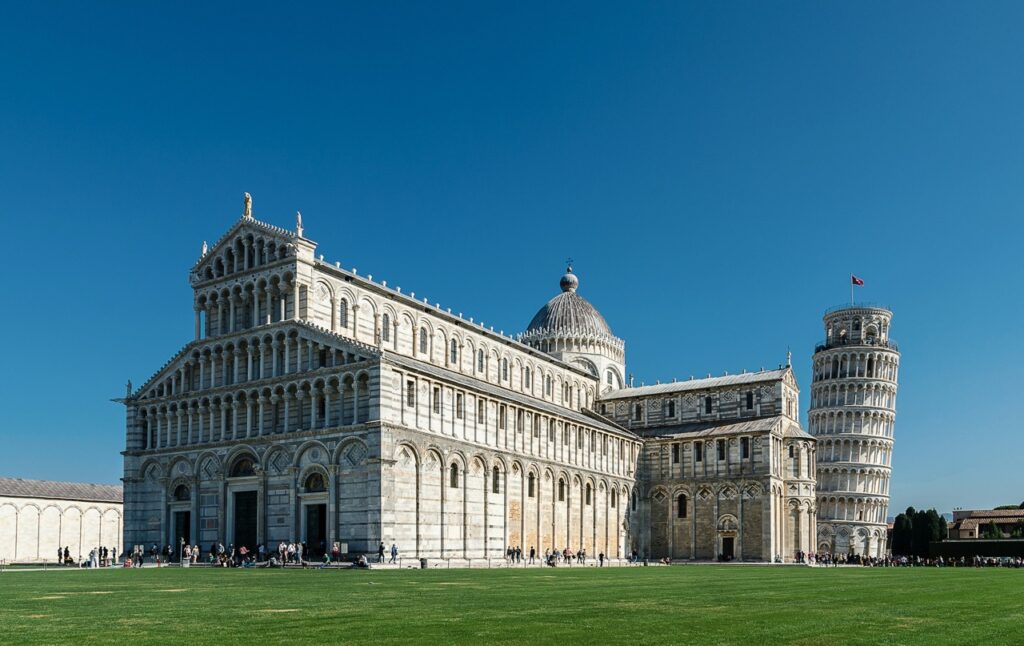
Pisa
The Pisa Cathedral, also known as the Cathedral of Santa Maria Assunta, is a stunning example of Romanesque architecture located in the Piazza dei Miracoli (Square of Miracles) in Pisa, Italy. It is part of a complex that includes the Leaning Tower, the Baptistery, and the Camposanto Monumentale.
Photo by alexey turenkov on Unsplash

San Gimignano
The medieval hill town of San Gimignano in Tuscany is world-famous for its striking skyline of towering, unadorned stone ‘skyscraper’ houses, which were built by rival noble families as imposing symbols of wealth and defensive strength during the Romanesque era. At the heart of the town stands the Collegiata di Santa Maria Assunta, a beautifully austere 12th-century Romanesque basilica featuring a classic, heavy stone facade and an interior entirely covered in vibrant, historically significant frescoes.
Photo by Piotr Dutko on Unsplash

Speyer Cathedral
Constructed from striking red sandstone in the 11th century, Speyer Cathedral is the largest surviving Romanesque church in the world and serves as a monumental symbol of Holy Roman Imperial power. Its perfectly symmetrical layout, incredibly thick load-bearing walls, and pioneering use of heavy, groin-vaulted ceilings established it as the ultimate architectural prototype for grand, fortress-like religious structures across medieval Germany.
Photo by J M Fisher on Unsplash

Tower of London
The Tower of London is anchored by the imposing White Tower, a quintessential masterpiece of 11th-century Norman Romanesque military architecture built by William the Conqueror to intimidate the local population with its massive, virtually impenetrable stone walls. Inside the keep lies the beautifully preserved Chapel of St. John the Evangelist, which perfectly exemplifies the heavy, unadorned strength of the Romanesque style with its thick cylindrical pillars, simple barrel vaults, and sturdy semi-circular arches.
Photo by Seymour Tseng on Unsplash

Sénanque Abbey
Nestled in a remote valley in Provence and surrounded by blooming lavender fields, Sénanque Abbey is a pristine, 12th-century masterpiece of Cistercian Romanesque architecture, built to reflect the order’s strict vows of poverty and simplicity. The abbey entirely lacks ornate decoration or towering spires, instead relying on the raw, harmonious beauty of its heavy stone masonry, small semi-circular arched windows, and a perfectly proportioned, unadorned barrel-vaulted ceiling designed to inspire quiet, spiritual contemplation.
Photo by Denis SHAO on Unsplash